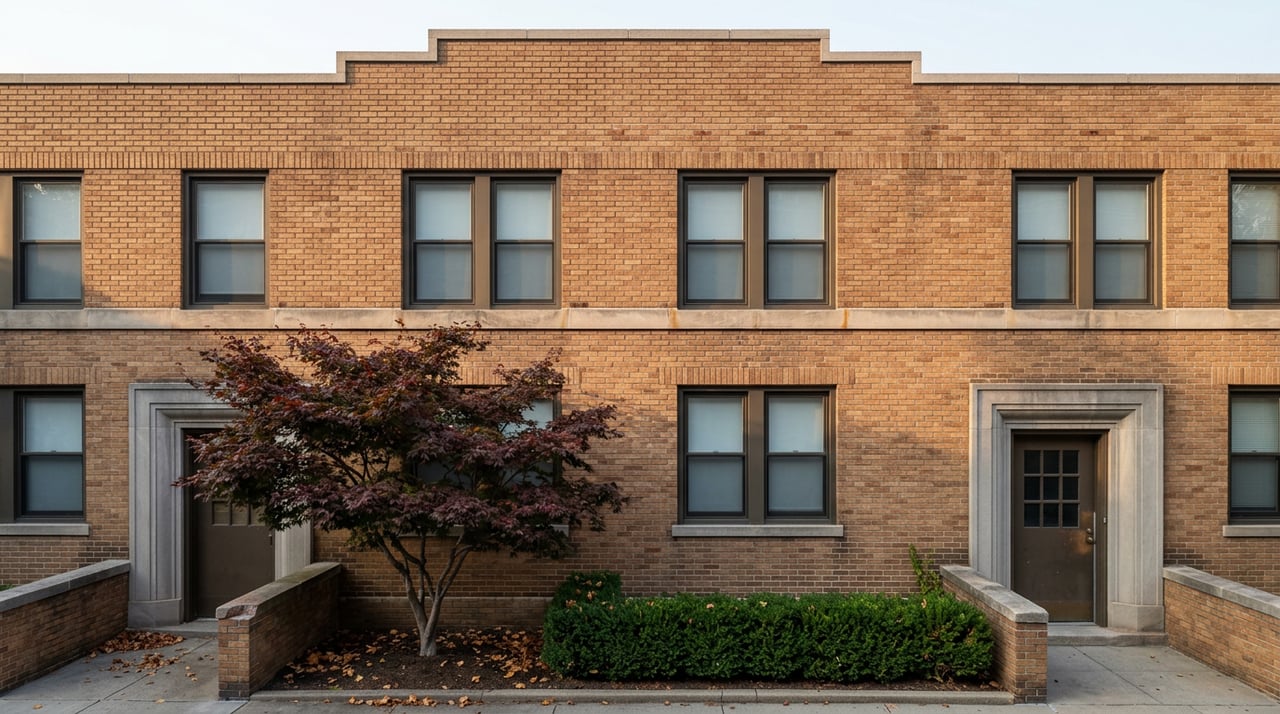
Woodside Queens Food and Neighborhood Life: Two Shared Traditions
September 10, 2026
September 10, 2026
Walk down Queens Boulevard to 58th Street and you'll find a small traffic median with a marker claiming to be the geographic center of New York City. It isn't. The actual center sits miles away in Bushwick, and nobody at City Hall signed off on the Woodside marker in the first place. Locals mostly ignore it.
Woodside carries a second belief about itself that isn't quite as wrong, but gets the order backwards just as badly. Walk two blocks over to Roosevelt Avenue and you'll hear people describe the strip as two competing identities stacked on top of each other: an old Irish pub row that got swallowed by a newer wave of Filipino restaurants and bakeries, as if one culture pushed out the other. That framing treats "Little Manila" as an invasion. The actual sequence runs the opposite direction, and understanding it changes how you read every storefront on that street.
Before Roosevelt Avenue had a nickname, Woodside was a predominantly Irish Catholic neighborhood built around parish life, the kind of place where a church basement doubled as the real community bulletin board. That infrastructure, not the food, is what mattered when the Immigration and Nationality Act of 1965 opened the door to a wave of Filipino professionals, many of them nurses and doctors recruited to staff nearby Elmhurst Hospital.
They didn't land in a neighborhood that resisted them. They landed in one already organized around Catholic parish networks, and that shared religious infrastructure gave newcomers a foothold instead of a fight. Woodside had the housing stock, the transit, and the church pews to absorb a new community without displacing the one already there. Decades later, Roosevelt Avenue's stretch of Filipino-owned restaurants, bakeries, and grocers is substantial enough that longtime residents still call it Little Manila without irony, a nickname that only sticks when the growth was additive rather than a swap.
That's the part the "two competing identities" story misses. Little Manila didn't replace Irish Woodside. It moved into a structure Irish Woodside had already built, and both threads have been sharing that structure ever since.
The commercial heart of Little Manila runs along Roosevelt Avenue roughly between 61st and 70th Street, and it earns the nickname on density alone. Ihawan anchors the strip with Filipino barbecue served on kamayan platters meant for sharing with your hands, no utensils. Phil-Am Food Mart down the block stocks ube desserts, lumpia, and balut alongside imported Filipino meats. Jollibee has a location right on Roosevelt for the fast-food crowd, and Tito Rad's, Krystal's Cafe, Red Ribbon Bakeshop, and Renee's Kitchenette and Grill round out a stretch where you could eat three meals without repeating a menu.
Walk a few minutes farther and the Irish pub tradition is still standing, not preserved behind glass but actually pouring drinks. Sean Og Tavern remains one of the neighborhood's working Irish anchors, and separately, at least one Woodside pub has kept its doors open since 1966, a year after the immigration law that brought the first wave of Filipino families to the area. That timing matters. An Irish pub old enough to have opened the year after that law passed is proof the neighborhood's older institutions were already standing when the new one showed up, not scrambling to compete with it after the fact.
Two menus, six blocks apart, and neither one had to win. Ihawan's kamayan platters and a pub that's been pulling pints since before the neighborhood had its second name aren't a coincidence of timing. They're the same chronology playing out on two ends of the same avenue.
If the food strip shows the overlap in daily life, Doughboy Park shows it in the neighborhood's calendar. The land was acquired by the city back in 1893 as a play area for students at local school P.S. 11. It proved too steep and overgrown for that purpose, and by 1957 it had been reassigned to NYC Parks and converted into a sitting area built around a 1923 bronze memorial to local World War I soldiers, ten of whom never came home. The park got its current name in 1971, and a 1959 street closure at 54th Street physically connected it to neighboring Windmuller Park.
That memorial function still drives the calendar. Every Memorial Day, Catholic War Veterans Post 870 marches from St. Sebastian's Catholic School at 57th Street down Woodside Avenue to Doughboy Park for a brief ceremony, a route that ties the neighborhood's oldest Catholic institution directly to its civic center. The same weekend, a separate and more secular tradition takes over a few blocks away: Woodside on the Move sponsors a street fair along Woodside Avenue between 63rd Street and Roosevelt Avenue, with food, fashion, music, and performances filling the same stretch of pavement that splits the pub row from the Filipino corridor.
The park doesn't belong to one calendar or the other. It's where a 1923 war memorial, a Catholic parade route, and a modern street fair all land on the same weekend, because the neighborhood never had two separate civic lives to schedule around.
Doughboy Park sits almost exactly between the two commercial strips, and that's not landscaping luck. It's the physical proof that Woodside's older institutions and its newer ones were never operating on parallel tracks. They share a park, a weekend, and in the case of the war veterans' march, a starting point at a Catholic school that's been part of the neighborhood since before Little Manila had a name.
You don't need a special occasion to see both threads at once. A short walk covers it:
None of this requires choosing a side. The strip was never built for that.
Woodside rewards the kind of attention that looks beyond the center-of-the-city marker to the neighborhood story two blocks away. If you're weighing a move into this part of Queens, or you already call it home and want a clearer read on how the neighborhood actually works block by block, Nelson Aybar knows Woodside at the level of which pub opened first and which parish still organizes the parade. Get help in a New York minute, in English or Spanish, whenever you're ready to talk about what's next.
Stay up to date on the latest real estate trends.
Hardworking, goal-driven, and passionate Real Estate Professional has more than 18 years of experience in Business Operations and Real Estate Sales. Possess a unique ability to duplicate success within diverse marketplaces. Committed to providing the highest level of service possible. Contact him to learn more!